
Tag: genre

Shoegaze: The ’90s Rock Genre Once Again Gains Ground

Are you a fan of guitar- and distortion-heavy rock artists like My Bloody Valentine, Catherine Wheel, and Ride? Then you’re into shoegaze. Yes, despite the unique name, it’s a real genre— and one seeing a recent resurgence.

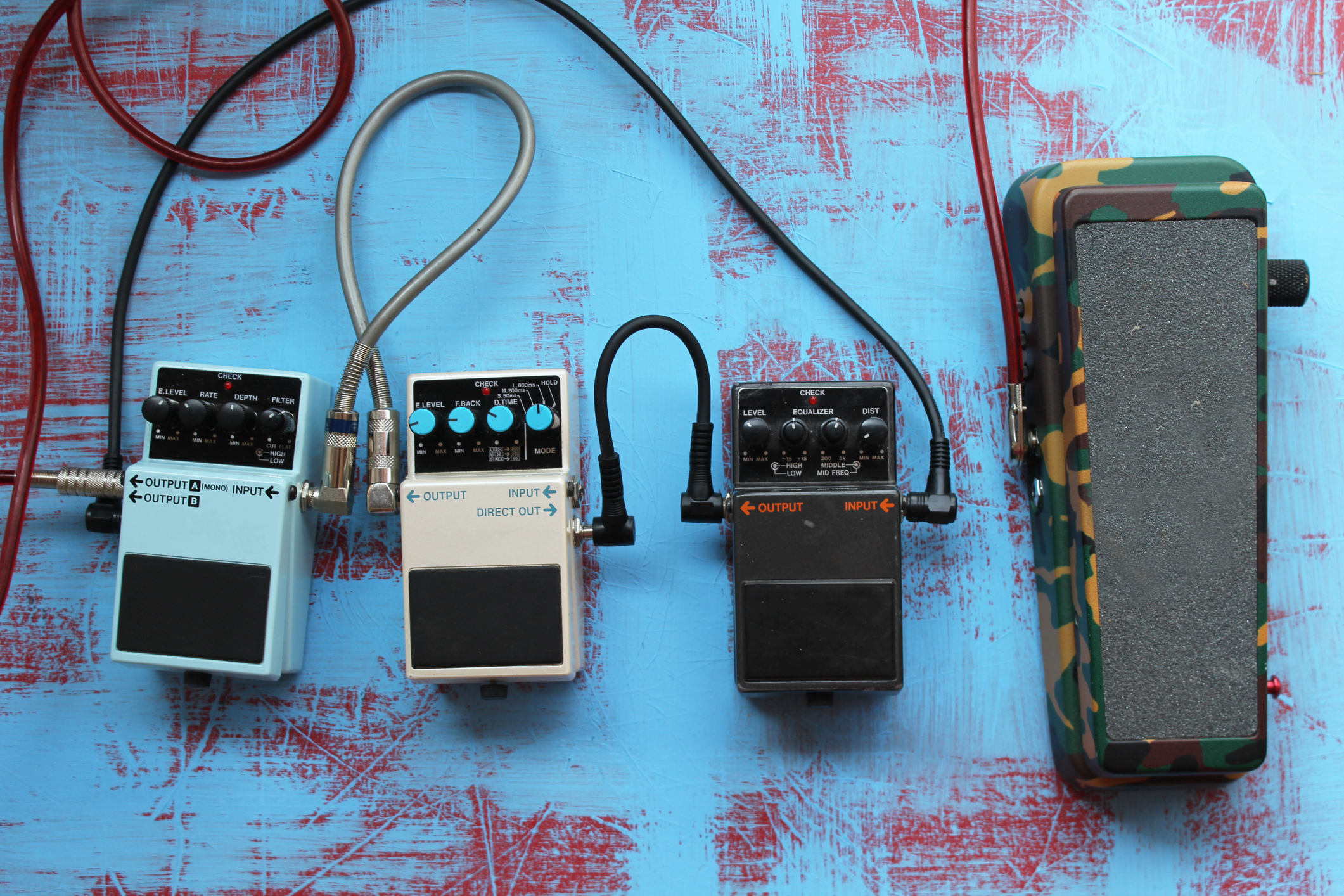
So just how did shoegaze gain a foothold? English music journalists in the early 1990s noticed that certain bands were looking down at their feet throughout their performances—and not out at the crowd. These artists weren’t putting on an air of indifference, though. They were meticulously working their banks of guitar pedals. This allowed them to transform their music into loud, gauzy layers of distortion, fuzz, delay, tremolo, and countless other woozy sonic effects.

The Jesus and Mary Chain is often credited as providing the foundation for shoegaze as early as 1985, with interlaced power chords and howls of feedback and guitar noise. But ultimately, the shoegaze genre hit its stride in 1991 with My Bloody Valentine’s Loveless album, as well as releases from Chapterhouse, Lush, Moose, Slowdive, and Swervedriver. They, in turn, influenced other ’90s-founded bands like Blonde Redhead and Scottish stalwarts Mogwai. Shoegaze became defined by layers of effects and, of course, volume.

Shoegaze peaked in 1996 in terms of number of releases. Then it went somewhat dark. Recently, however, many legends of the genre have reunited for tours and fresh albums. So if you see one of these bands live, bring earplugs. But keep your eyes open—you’ll see that the crowd is a mix of teenagers of the ’90s and, well, teenagers.

Explore shoegaze with this playable map: The bigger the artist’s name, the more popular they are on Spotify. Click the image to expand it.
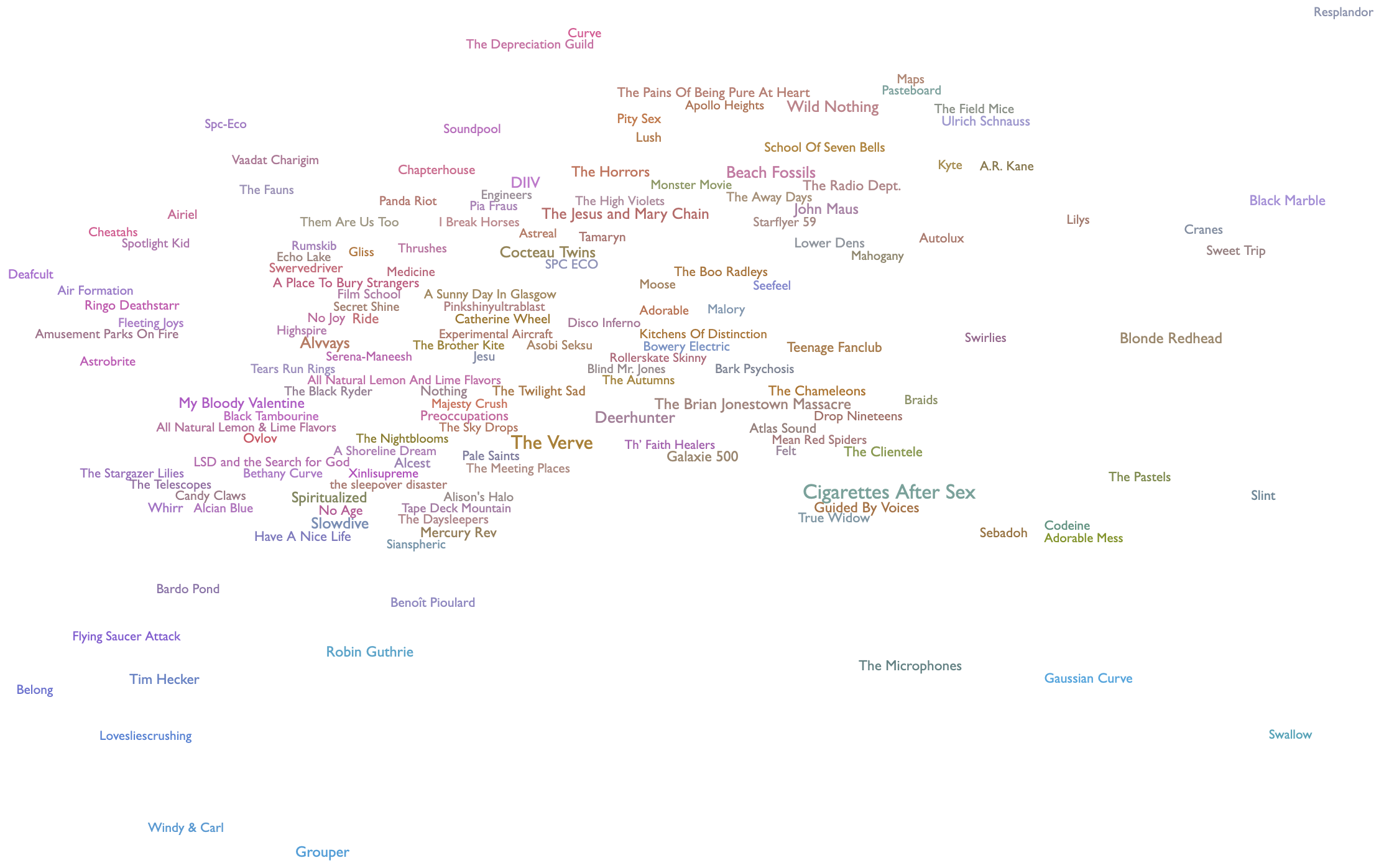
In 2018 there were twice as many shoegaze recordings released (or rereleased) as in 1996. If you were into shoegaze back then, you are likely listening to the music now since Gen Xers stream the genre’s artists on Spotify at a higher rate than any other age demographic. And while shoegaze started in the UK, today the music is streamed the most in Portugal, Greece, Israel, and Lithuania—and most modern shoegaze bands aren’t British, they’re American.

Among the young up-and-comers pushing the genre forward and in new directions are Flyying Colours, No Joy, and The Pains Of Being Pure At Heart. Shoegaze is not only back, it’s actually spawning several subgenres. Things are, dare we say, looking up for looking down.

Not sure where to start with shoegaze? Check out one of these playlists:

The Sound of Shoegaze: Defining tracks that stood out from the rest

The Edge of Shoegaze: Recent, lesser-known music streamed by shoegaze fans

Dreamy & Distorted: Spotify’s main shoegaze playlist

ASMR’s Soft Sounds Are Making Noise on Spotify

Shhh, come closer and listen to chill whispers and the sound of tapping on pineapples. No, this isn’t a joke—those are the soothing vibes ASMR (autonomous sensory meridian response) fans can’t get enough of. Whether you find it captivating or cringeworthy, ASMR is a hit on Spotify, clocking 2.1 million streams every day for the past three months.

ASMR is often described as a relaxing “braingasm” sensation that washes over devotees when they hear certain sounds like whispers, crumpling papertapping fingernailsjingling coins, or popping bubble wrap. Even the crunch of pickles being chewed has a sizeable audience.

So why are these goosebump-inducing, short streams of trigger noises attracting so many fans?

For some, it’s all about the effect. Listeners who find ASMR meditative can experience immediate mental and physical relaxation, according to David Kaplan, chief professional officer of the American Counseling Association. “You can’t be relaxed and stressed out at the same time,” he says. “Meaning, if you’re positively affected by ASMR, chances are your stresses will at least momentarily melt away.”

Celebrities are succumbing to the sound of semi-silence, too. Ariana GrandeCardi BJanet Jackson, and Jake Gyllenhaal all have held press interviews entirely in whispered tones.

Plenty of people, however, feel like their skin crawls when they listen to the sounds of ASMR. And anyone with misophonia, also called selective sound sensitivity syndrome, can’t stand ASMR. Sounds like chewing, lip-smacking, or swallowing will instantly trigger annoyance and anxiousness. Yet they’re pure bliss to ASMR lovers.   

The most-listened-to sounds on Spotify comprise as obscure an ASMR hit list as you might imagine. Tongue-clickingblowing in earsfolding nylon fabric, and the aforementioned tapping on pineapples top the chart. And they all transcend generations as well as geography. But ASMR is most popular in English-speaking countries (i.e., US, UK, Australia, New Zealand, and Canada), and listeners ages twenty-five to forty-four comprise the lion’s share of the streaming totals.

Curious if you’ll find ASMR soothing or strange? Check out our ASMR playlists, including Sleep Sounds, Trigger Sounds, and Binaural Beats—pineapple tapping included, of course.

Interested in giving ASMR a try, but not sure where to start? Try a tapping playlist.

Is It Too Early for Christmas Music?

These days stores start cranking out yuletide tunes faster than you can say Black Friday. Santa’s elves (and you know they’re everywhere) have been waiting to hear jingle bells since July. Kids, of course, are counting down. Grinches may protest, much preferring a silent night over little drummer boys a moment before December 24. But with millions of Christmas-themed playlists streaming throughout the festive season, we set out to answer the age-old question: How early is too early for Christmas music?

Depending on where you live, the answer is never.

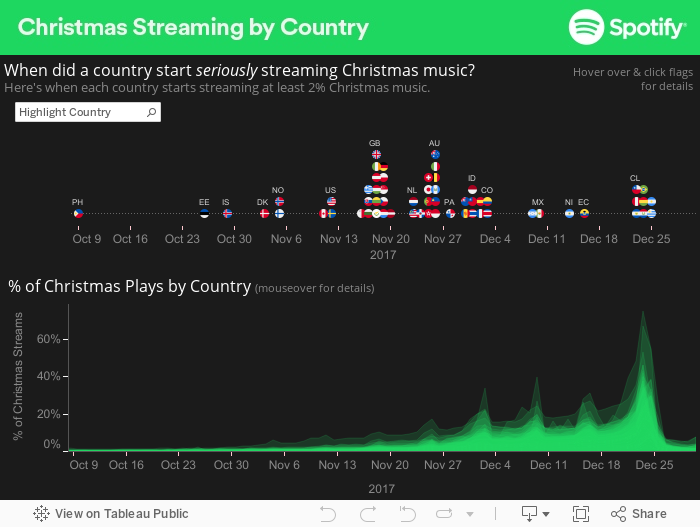
In our eyes, a country has officially started the jingle bell rocking once festive tunes make up more than 2 percent of all listening in the region. On average, most countries start hitting play on holiday hits towards the end of November. But as you can see in this interactive graphic, that’s not the case for all:

According to holiday streaming in 2017, most countries see the first surge in listening around November 1—unless you live in the Philippines.

The Philippines takes Christmastime very seriously—and kicks off the season months before any other country. To celebrate the holiday for as long as possible, Filipinos start shuffling their holiday playlists as early as September. And while they can’t get enough of the global top holiday hits, they also love to stream local veteran singer Jose Mari Chan, whose song “Christmas In Our Hearts” is a favorite in the region.

Not everyone is in such a rush. Some countries, like Argentina and Uruguay, wait until Christmas Day itself to start listening. The United States and Canada wait until November 13 to start—but once they get going, “All I Want For Christmas is You” is on repeat until the reindeer come home.

But no one gets quite into the Christmas spirit like Liechtenstein: Though off to a slow start, in the few days before December 25th, almost 70 percent of all listening is exclusively Christmas music—triple the global average for Christmas listening.

Yet no matter when they get into the spirit, listeners on Spotify worldwide have created over 21 million Christmas-themed playlists full of tried-and-true Christmas classics, from the likes of Frank Sinatra and Brenda Lee to today’s jingle ball jams by Ariana GrandeMichael Bublé, and Justin Bieber. Also check out our global playlists, Christmas ClassicsChristmas Pop, and Christmas Jazz. (Or if Hanukkah is more your style, we’ve got that too.)

Whether your gift-bringer is Santa Claus, the German Christkind, or the Niños Dios of Costa Rica, get ready to turn up the volume on Christmas music in the 50 days to come. (But who’s counting?)

When Do People Listen to EDM?

Electronic dance music, or EDM, began as a fringe movement with roots in the diverse music scenes of the ‘70s and ‘80s—disco, Detroit techno, hip-hop, dub, and more. Since then, EDM has become a powerful cultural force with a sound you can hear in everything from mainstream pop to the most arcane, underground electronic genres from around the world.

Central to the concept of electronic dance music, obviously, is the communal act of people getting together in real life to dance in the same place, on the same night, as a shared musical experience. That’s what attendees of the Amsterdam Dance Event (ADE) will be doing for the next four days (October 17-21).

Yes, this music was created for dancing together, but EDM fans can’t live at the club forever. So when do they stream EDM? The answer surprised us at first, but it actually makes sense:

People think of EDM as nighttime party music, but when it comes to their streaming habits, we see that they’re mostly listening in the afternoons and early evenings—especially on work and school nights. It could be that high-energy EDM music is just what these folks need to get through a stressful afternoon workday.

There’s another factor at play here: People listening to EDM while getting ready for the club. If we go beyond what’s in the chart above, we find that the day with the most EDM listening in the afternoon and early evening is Friday. It’s possible that club goers and party people are streaming EDM as they get ready to go out for the night.

But by late evening and nighttime—the times of day most associated with EDM in our popular imagination—EDM streaming dips lower than at any other time. Apparently, people who love EDM are either listening to something else at night, or they’re out dancing.

What’s also fascinating about EDM is that it bucks the trend of other genres prevalent at certain times, by increasing in the afternoon and evening when other genres, such as atmospheric, dip lower:

Looking to stream some of the hottest new EDM hits? Here’s the official Spotify playlist of the Amsterdam Dance Event.

— Article by Eliot Van Buskirk, Data/research by Jomar Perez

11 Dance/Electronic Subgenres Heating Up This Summer

Dance and electronic music is known for its power to unite fans from across the globe, but real aficionados agree that there’s no one way to blend the many styles, sounds, and artists that make up the expansive and ever-evolving genre.

“The electronic music genre umbrella has to be the largest musical classification. It’s crazy how so many descriptors were accepted throughout its evolution,” says Spotify Dance editor Austin Kramer. “House, rave, club, EDM, dance, electronic are all part of the culture. The semantics all dissolve to one thing: how it makes you feel.” He praises Tomorrowland, which just wrapped two epic weekends, as an example of a popular festival that truly embraces “the diversity of dance music.”

According to Kramer, Tomorrowland hosts more breakout artists than many similar, large-scale festivals. But whether you nabbed a ticket to Belgium or not, there’s still a way to discover and connect with these new and rising artists.

If you’re a dance fan, you probably follow Spotify’s flagship playlist, Mint. Still, you might not know about Spotify’s many dance and electronic subgenre playlists, which house a veritable treasure trove of emerging (and established) artists within bass, indie, techno, and more.

According to diehard fans and experts like Kramer, there’s simply “no way to classify” the many subgenres (and sub-subgenres, and sub-sub-subgenres) that make up the growing dance/electronic/club scene. But while it’s impossible to neatly categorize, it is possible to explore the genre’s limits via Spotify.

Check out our Mint playlist right here, and then learn more about some of our other favorite styles below.

Featuring fast kicks, cymbal smacking, wobble leads, and noted Jamaican dub and reggae influences, Drum & Bass grew from the rave and jungle scenes of Britain in the early 1990s.

Future House is a subgenre that fuses electro/deep house with meaty bass lines. It can bounce and build.

Trap blends hip-hop production (hats, kicks, vocal cuts) with bass drops and large-room effects in halftime.

House originated in Chicago post-disco by mixing funk/soul samples on top of electronic synths/instruments and drum machines (though it now varies in style and influence). House can be seen as the style of music and its variations, but also as a movement and philosophy of unity and love, and the stem of dance music culture today.

Indie Dance/Electronic is a subgenre that fuses rock and electronic. Styles include synth pop, alternative dance, future bass and nu disco.

Characterized by its use of melody, Trance was another early style that’s been evolving for decades. Soaring builds, anthemic, uplifting, hard-hitting chords; a true culture in itself.

Techno is defined by repetitive instrumentals and futuristic themes, ranging from delicate melodic soundscapes to throbbing industrial beats.

Melodic Bass incorporates intense bass lines, colorful melodic builds, and airy drops.

Tech House fuses the minimalistic characteristics of techno with the swing of house.

Afro House/ Soulful House blends African music with house beats.

Fast and hard, Hardstyle is a subgenre that combines distorted leads, euphoric melodies, and face-melting kick drums.

Subscribe to Spotify’s dance playlists to stay updated on the latest and greatest in electronic music.

Straight Out of the Favela: Brazilian Funk

If you haven’t heard of Brazilian funk (or Baile Funk) yet, you will soon. Pumping hard from the heart of Rio de Janeiro, the genre derived from Miami bass and gangsta rap is blowing up across the world. With its infectious looping tamborzão rhythms and raw party anthem lyrics, Brazilian funk is twerking its way to the top of the charts. (After all, twerking is basically the unofficial dance of the genre.) And a rising new generation of funkeiros—AnittaMC KevinhoMC Fioti, and Ludmilla among them—are fueling the movement.

Brazilian funk star Anitta (née Larissa de Macedo Machado), who became a breakout sensation after singing in her home city of Rio at the 2016 Olympic Games, is catapulting the Miami bass and gangsta rap-rooted Afro-Brazilian genre into the global spotlight on Spotify.

Last December, just 12 hours after releasing “Vai Malandra” (feat. Tropkillaz & DJ Yuri Martins), the silky-voiced singer laid claim to the first Portuguese-language song to land on Spotify’s Global Top 50 chart.

“It’s a great time for Brazilian funk music because we have some great artists investing in it and producing great hits with funk beats,” Anitta said. “Tropkillaz, Major Lazer, me and many other artists are helping making this moment even hotter. A good example is MC Fioti’s song, “Bum Bum Tam Tam,” that exploded on Spotify. He even made a collab with J Balvin after that. It makes me really happy to see funk getting recognition worldwide.”

Empowered by the unparalleled freedom and exponential reach of digital music online, outspoken female Brazilian carioca artists like Anitta—along with protest rapper Karol Conka, feminist icon Valesca Popozuda, 18-year-old São Paulo prodigy MC Rita, and a growing wave of trailblazers like them—have been leading the way toward globalizing the genre. Anitta joins an eclectic cadre of bold voices including Ludmilla, MC Loma e As Gêmeas Lacração—and the list goes on.

“Seeing the explosion of Brazilian baile funk gives me the feeling that we are doing our role well as a label and in media, but at the same time it proves that this is the tip of the iceberg, which can be much larger and explore other territories,” says Brazilian music video director and producer Kondzilla. “Baile Funk as a genre is lively and contagious. The music industry is already watching.”

See for yourself just how quickly this viral music genre has spread like wildfire across the world from 2016 to 2018.

Music experts around the world are being wowed by this growth. “Brazilian funk is a true world phenomenon,” said Roberta Pate, Spotify’s Artists & Label Services Manager for Latin America and US Latin Markets. “In the last two years, the genre has broken the barriers and boundaries of Rio de Janeiro’s favelas, and Brazil, to win the world. It’s now one of the most heard genres in Europe, North America and Central America.”

One Funk producer can release up to 100 original songs per month, and with every bass-bumpin’ beat streamed, the democratizing power of the Internet rapidly catalyzed the spread of already speedily produced funk far beyond Brazil’s favelas and onto a worldwide stage.

“Spotify and the Internet are great instruments for spreading good music around,” said Anitta. “It’s powerful, simple and fast, and it makes things easier for different artists to show their songs with Spotify.”

“The great partner of artists like Anitta, MC Kevinho, MC Fióti and Ludmilla, is the Internet, more precisely Spotify and music streaming services, which allowed this phenomenon to expand outside Brazil,” Pate said. “Proof of this success away from home and its internationalization, funk has a playlist focused on international users on Spotify, called Mother Funk.”

“Mother Funk,” the Brazilian funk-filled Spotify playlist, tells the history of funk, with greatest hits from the 80’s until today. It’s especially popular in the United States, Portugal, Argentina, Paraguay and Mexico. To hear what all the buzz is about—top songs from Anitta, Dani RussoMC Kevinho and DJ Malboro included—check it out here.